ISME20 — 20th International Symposium on Microbial Ecology
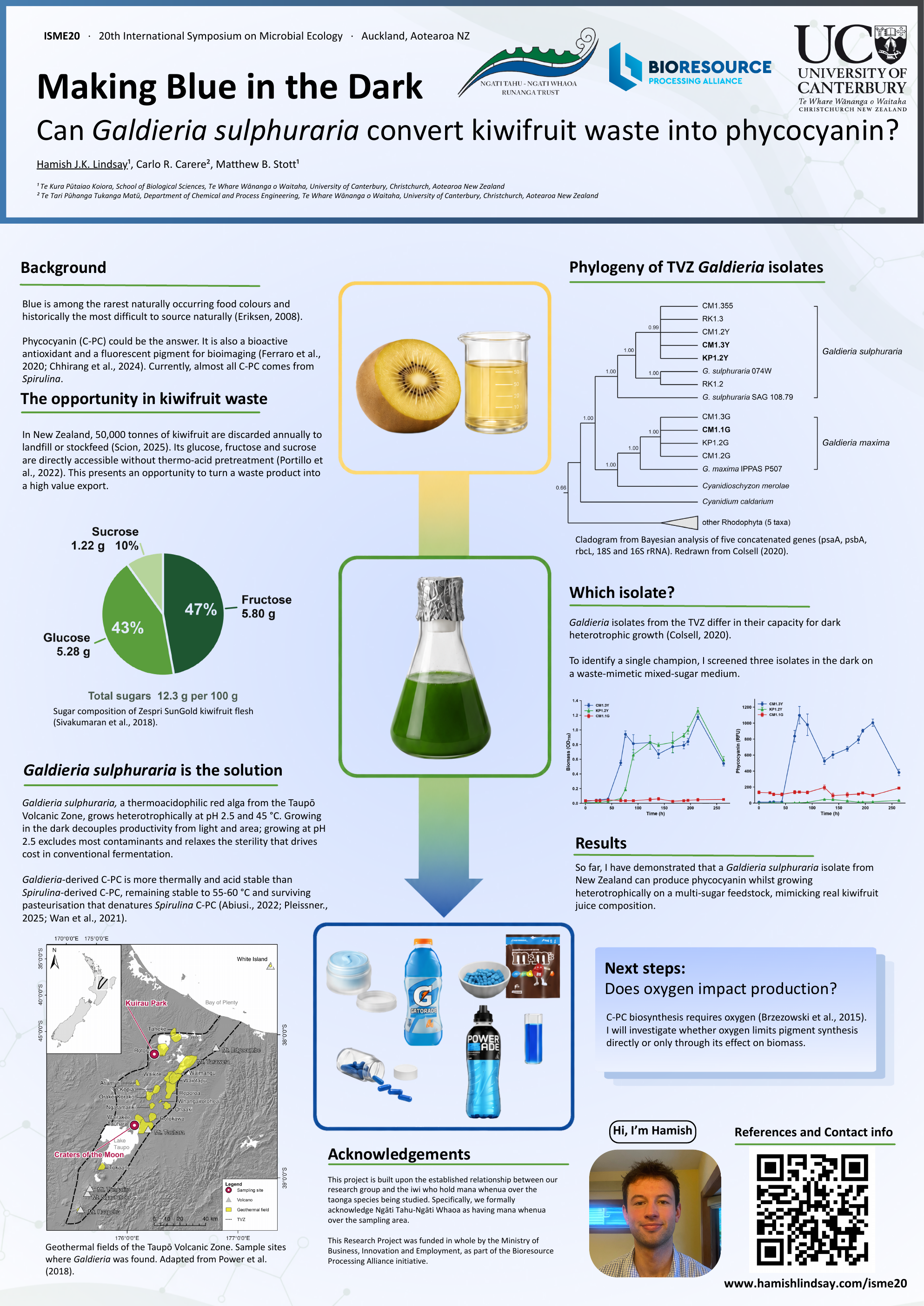
Can Galdieria sulphuraria convert kiwifruit waste into phycocyanin?
Hamish Lindsay
School of Biological Sciences, University of Canterbury, Christchurch, New Zealand
Auckland, Aotearoa New Zealand · 2026
University of CanterburyBioresource Processing AllianceNgāti Tahu–Ngāti Whaoa Rūnanga Trust
References
Everything cited on the poster.
Shortened APA 7th. Links go to the DOI or publisher record.
- Abiusi, F., et al. (2022). Mixotrophic cultivation of Galdieria sulphuraria for C-phycocyanin and protein production. Algal Research, 61, 102603. Link
- Brzezowski, P., Richter, A. S., & Grimm, B. (2015). Regulation and function of tetrapyrrole biosynthesis in plants and algae. Biochimica et Biophysica Acta – Bioenergetics, 1847(9), 968–985. Link
- Buckeridge, E., et al. (2024). Substrate and nutrient manipulation during continuous cultivation of extremophilic algae, Galdieria spp. RTK 37.1. Biotechnology and Bioengineering, 121(11), 3428–3439. Link
- Chaiklahan, R., Chirasuwan, N., & Bunnag, B. (2012). Stability of phycocyanin extracted from Spirulina sp.: Influence of temperature, pH and preservatives. Process Biochemistry, 47(4), 659–664. Link
- Chhirang, P., Gahlawat, V. K., & Singh, B. P. (2024). Phycocyanin: A potential bioresource for functional food product development. South African Journal of Botany, 174, 49–65. Link
- Colsell, A. (2020). Cultivation, isolation and characterisation of thermophilic and acidophilic red algae, Cyanidiales. MSc thesis, University of Canterbury.
- Eriksen, N. T. (2008). Production of phycocyanin: A pigment with applications in biology, biotechnology, foods and medicine. Applied Microbiology and Biotechnology, 80(1), 1–14. Link
- Ferraro, G., et al. (2020). A thermophilic C-phycocyanin with unprecedented biophysical and biochemical properties. International Journal of Biological Macromolecules, 150, 38–51. Link
- Office of the Prime Minister's Chief Science Advisor (2024). Food waste series report 3: Beyond the bin — capturing value from food waste. OPMCSA, Auckland. Link
- Pleissner, D. (2025). Long-term heterotrophic cultivation of Galdieria sulphuraria at technical scale under non-sterile conditions. Preprint.
- Portillo, F. V.-L., et al. (2022). Growth and phycocyanin production with Galdieria sulphuraria UTEX 2919 using xylose, glucose, and corn stover hydrolysates. Algal Research, 65, 102752. Link
- Power, J. F., Carere, C. R., … Stott, M. B. (2018). Microbial biogeography of 925 geothermal springs in New Zealand. Nature Communications, 9, 2876. LinkOutput of the 1000 Springs Project, led by principal investigator Matthew B. Stott.
- Reimão, M., et al. (2025). Colouring applications of microalgae and cyanobacteria photosynthetic pigments: Challenges for industrial and market acceptance. Journal of Cleaner Production, 520, 146071. Link
- Reynolds, C., Mirosa, M., & Clothier, B. (2016). New Zealand's food waste: Estimating the tonnes, value, calories and resources wasted. Agriculture, 6(1), 9. Link
- Sarian, F. D., Rahman, D. Y., Schepers, O., & van der Maarel, M. J. E. C. (2016). Effects of oxygen limitation on the biosynthesis of photo pigments in the red microalgae Galdieria sulphuraria strain 074G. PLoS ONE, 11(2), e0148358. Link
- Schmidt, R. A., Wiebe, M. G., & Eriksen, N. T. (2005). Heterotrophic high cell-density fed-batch cultures of the phycocyanin-producing red alga Galdieria sulphuraria. Biotechnology and Bioengineering, 90(1), 77–84. Link
- Scion (2025). Turning kiwifruit waste into high-end materials. Scion news release. Link
- Sivakumaran, S., Huffman, L., Sivakumaran, S., & Drummond, L. (2018). The nutritional composition of Zespri SunGold kiwifruit and Zespri Sweet Green kiwifruit. Food Chemistry, 238, 195–202. Link
- Thevarajah, B., et al. (2022). Large-scale production of Spirulina-based proteins and C-phycocyanin: A biorefinery approach. Biochemical Engineering Journal, 185, 108541. Link
- Wan, M., et al. (2016). A novel paradigm for the high-efficient production of phycocyanin from Galdieria sulphuraria. Bioresource Technology, 218, 272–278. Link
- Wan, M., et al. (2021). Comparison of C-phycocyanin from extremophilic Galdieria sulphuraria and Spirulina platensis on stability and antioxidant capacity. Algal Research, 58, 102391. Link